Skip to content
Movement & Sports Medicine Centre
  • Home
    • About MSMC
      • Product
      • Jab Senior SMT
    • Privacy Policy
    • Reads
    • T/Cs
  • Tools
    • Intermittent Fasting Calculator
    • Heart Rate Zone Calculator
    • Breathing Rate Calculator
    • Daily Macro Calculator
    • 1 Rep Max Calculator
    • Body Composition Calculator
  • Membership Rates
    • PT Memberships
      • PT Membership T&Cs
    • Studio Memberships
    • Personal Training Rates
      • PT T&Cs
  • Classes
    • Bookings
    • Ice Bath
  • Contact
    • Find us
    • Private Sessions
    • BreathEra Programme License
      • About Neuro Series
      • NeuroMap®
      • NeuroTune®
      • NeuroScope®
      • NeuroCalm®
      • NeuroSync®
      • NeuroRoot®

Categories

All Aerial Breathing Cupping Cupping Therapy Ice Bath Knee Pain Meditation News Pain Personal Training Recovery Self Help Stretching Training Weight Loss Yoga

2/16/2020

Best Steel Mace & Clubbell Exercise | Beginners

While searching google Find easy to follow macebell & steel mace exercise instructions that will make you stronger & injury resistance. Each of the exercise follows the order of being easiest to hardest, simplest to complex. 
Related guides: Steel mace | macebell · Learn 16 benefits of Steel| Mace bell · What Are Indian Clubs? The Complete Guide to Indian Club Training, History & Benefits

1. Point "Zero"

Picture
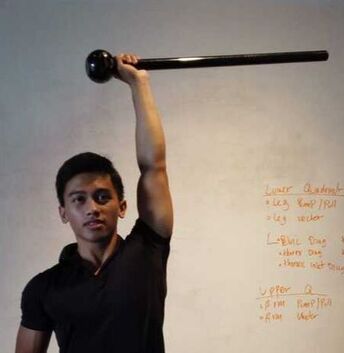
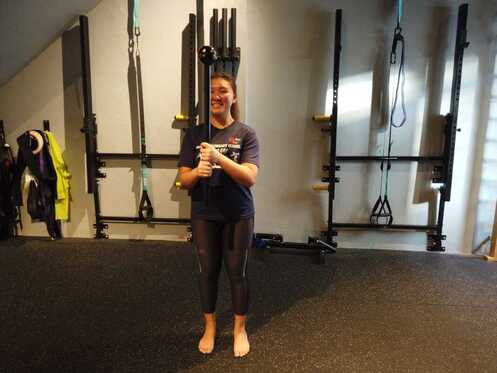
This position is known as "Point Zero", where you take most of the simplest to most complex transitions from. Grip & offset your weight according to your comfort and current strength, if you don't know how to handle a mace, we have a short article that explains clearly why & how to do it.
AIM: Point Zero as well is a great way to start training your grip strength & start learning how to stabilise the mace upright, keeping your shoulders low, elbows close to your body.
TIPS:

  1. Work your way down towards the tail
  2. Work towards holing it for time & do multiple sets(eg 10sec, 20sec 45 secs etc)
  3. Eyes look only at the head(ball) whilst moving, this is to ensure that you know where the head is traveling to & quickly counterbalance keeping it upright at all times. 

2. Single Arm Point Zero (alternate grip)
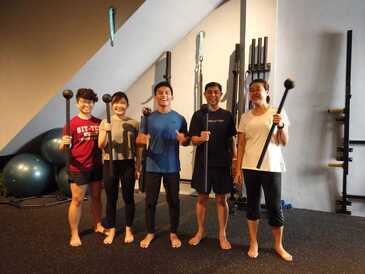
5 steel mace users at msmchq

Start alternating your grip!

Start getting stronger by layering the work from above & adding this slowly. If you feel you cannot complete this exercise, always go back tp the previous exercise to make it stronger & more stable before moving on. This creates a very stable base for your movement & lowers your chances of injuries. 
​Aim: Starting your single arm grip strength individually, enhance hand-eye co-ordination, increase activation of rotator cuff, increase core activation, increase sensory receptors engagement.
TIPS: 

  • Work your way down towards the tail 
  • Eyes keep looking at the head or ball

3. Single Arm Point Zero Push

Aim: To be able to get stronger in grip, forearms, shoulders, lats and core.Start by slowly extending your arm forward, little by little &  quickly but smoothly bring it back to close to you. Move with intent so that your movements are always controlled. 
TIPS: 

  • Work towards the tail 
  • Work towards holding for time and distance away from your body
  • Engage your grip harder
  • Engage your shoulders down to active your lats(think longer neck)
  • Eyes peeled onto the head or ball

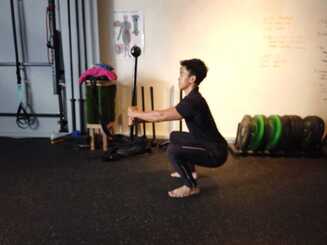
4. Point Zero Squat
Picture
Aim: To activate your core whilst squatting, increase balance, increase engagement of proprioceptors, increase overall awareness of your body. Simply start by placing the mace in Point Zero & as you start descending into a squat, push the mace out with both arms & stabilise the mace. As you come back up, simply bring it back close to you.
TIPS: Keep the body in the best form possible without rounding the back or going too fast as that will increase the chances of injuries from the deep stabilisers muscles not being able to engage efficiently. Squat only to the best abilities you can do, whatever the range of motion is & strive for progression, not perfection. 

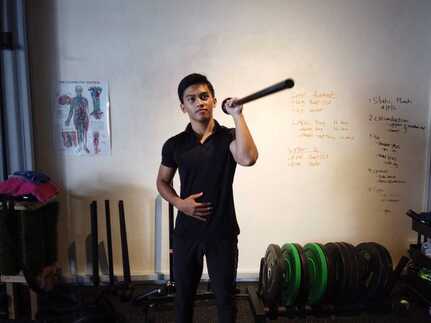
5. Offset Standing Press(ball in)
Picture
Picture
Aim: To load the shoulder in a off-centre force(centre of gravity) that takes you closest to the centre of your body, challenging the deep stabilisers from the rotator cuff, & the wrist to stabilise under low load. 
​TIPS: Keep the elbows and wrists travelling together

6. Offset Standing Press(ball out)

Aim: To load the shoulder in a off-centre force(centre of gravity) force that takes you furthest away from the body to the centre of your body, challenging the deep stabilisers from the rotator cuff. 
​TIPS: 

  • ​Always make sure the body of the mace bell is straight and not in an angle. 
  • ​​Movements are done slow & controlled.
  • Chin stays neutral throughout & stop before fatigue. 

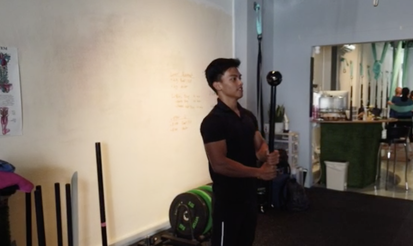
8. Samurai Chop
Picture
Picture
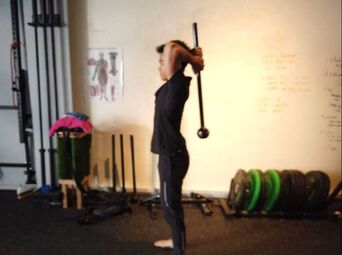
Aim: To load the shoulder in a centrifugal force that takes you closest to the centre of your body, challenging the deep stabilisers from the rotator cuff. 
​TIPS: ​

  • keep elbows facing forward when bringing the steel mace / macebell behind your head 
  • chin neutral throughout the movements 
  • move slowly through the range of motion to lower than chances of injury
  • pause in the bottom end of the range of motion when the steel mace is behind your back
  • not to hold your breath when doing the exercise
  • never be in pain when doing this, modify position if needed

9. Samurai Chop / Squat

Aim: To load the muscles in the: 

  1. Wrists
  2. Forearms
  3. Triceps
  4. Shoulders 
  5. Rotator Cuffs
  6. Chest
  7. Abs 
  8. Hips 
  9. Thighs 
  10. Hamstrings 
  11. Calves 
  12. Plantar Fascia(bottom of the feet)

​TIPS: ​Slow down the movement to engage each muscle's firing pattern &. Make sure to always have the steel mace/ macebell in the centre of your body & to place your elbows facing the front at all times throughout the movements. Engage the lats when you're bringing the mace forward from the back of your body, & last but not least, to breathe & not to hold your breath to allow your nervous system's feedback loop to "think" it is a safe movement under tension or load. 

Well there you have it, the best movements for beginners to learn & practise. Use the moves in a set or for a set amount of time, or just practise it for a few shorts moves. Until you feel that you can extend the duration, repetitions, & sets, keep doing them in the best form possible. You will be able to get the body strong from all angles, bullet proof it from injury and even get your rotator cuffs & hips stable, encouraging movements under stable environment. As always if unsure, seek a professional for advise if this would be safe for you if you have any current existing medical condition(s). 

PS: To get the best out of your session, always stop before fatigue, rest in between your exercise so that your nervous system is not taxed to perform each repetition with the intent that you set out to do. This helps with full engagement of the brain to muscles firing rate. 

Attend a class

About the author

MSMC, Movement & Sports Medicine Centre

Movement & Sports Medicine Centre (MSMC) is a sports medicine fitness studio at 151A Kitchener Road, near Farrer Park MRT in Singapore. Since 2019, MSMC has helped hundreds of adults, most of them 35 to 60-plus, get out of pain, move better & build lasting strength through evidence-based movement, strength & recovery programmes.

MSMC was founded by Jab, a sports medicine personal trainer with over two decades of experience in exercise science & functional training, who trained in osteopathy & sports medicine. Today a team of certified, sports medicine trained (SMT) personal trainers works alongside physiotherapists & starts every programme with a full movement assessment, because at MSMC “we test, we don’t guess”.

MSMC’s services include personal training at the studio or at home (arranged on WhatsApp), strength training for over-50s, back & knee rehabilitation, injury prevention, Functional Stretch Therapy (F.S.T), aerial stretching, blood flow restriction (BFR) training & a monthly sound bath. Find us or message us on WhatsApp +65 8973 7619.

This article was written by the MSMC team & reviewed by a sports medicine trained trainer. It is general information, not medical advice: if you have pain or a health condition, see a doctor or get assessed before you start.

Location

151 A #02 
Kitchener Road 
S(208526)
Train Station: Farrer Park
"Health is not to be treasured in the absence of it." 


​Copyrights Movement & Sports Medicine Centre 2025

info@msmchq.com

WhatsApp
+65 8973 7619
Mobile operating hours:
12pm-6pm (weekdays only)
​Weekend(closed)


Centre's Operating hours:
Weekdays 11am -9pm
Weekends closed
To visit us, kindly get in touch with us as we're an appointment based studio


Rights reserved