
If you've just got your bone scan back, the difference between osteopenia vs osteoporosis is how low your bone density is. A T-score between -1.0 & -2.5 is osteopenia (low bone mass); -2.5 or below is osteoporosis (bones weak enough that fracture risk is clearly higher). And yes, you are allowed to exercise. For most women after menopause, the right exercise is one of the best ways to protect your bones & your hips.
Last updated: 26 November 2026. Written by the team at MSMC (Movement & Sports Medicine Centre), a sports medicine personal training studio at Farrer Park, Singapore.
Key facts: osteopenia & osteoporosis
- Both are found on a DEXA scan of the hip & lumbar spine, sometimes the wrist.
- T-score -1.0 or higher: normal. -1.0 to -2.5: osteopenia. -2.5 or below: osteoporosis.
- Most hip fractures happen after a fall, so leg strength & balance matter as much as the number on your report.
- Resistance training, impact exercise & balance training are recommended for bone health at both stages.
- If osteoporosis affects your back, avoid loaded deep bending & twisting.
- Calcium, vitamin D, not smoking & keeping alcohol low all support your bones; some medical conditions & medicines speed up bone loss.
"Do some exercise": what your doctor didn't have time to explain
Many women leave the clinic with a T-score, maybe a calcium prescription, & the words "do some exercise". Then the worry starts. Is it safe to carry the marketing home from the wet market? Should you stop yoga? What if you fall like your mother did? This guide turns your report into a plan you can start this week, & shows what's safe at each stage.
Bone formation, bone loss & why scores drop
Bone is living tissue. Cells called osteoclasts break old bone down, while osteoblasts handle bone formation, laying new bone down. Until about 30, bone formation wins & bone mass builds. After menopause, when oestrogen falls, bone loss speeds up for several years. Medical conditions such as rheumatoid arthritis or an overactive thyroid, & long-term steroid medicine such as prednisone, can speed it up too.
Your scan report in plain English: T-score & Z-score
If your doctor referred you for bone testing, ask for a copy of the report. You'll see two numbers.
- T-score compares your bone density with a healthy young woman (men are compared with young men). It's the score used to determine whether a person has osteopenia or osteoporosis after menopause. -2.5 is the threshold for osteoporosis.
- Z-score compares you with women of your own age. A Z-score of -2.0 or below is lower than expected, & your physician will usually look for a cause.
The report may list several sites (spine, hip, femoral neck). Your diagnosis usually comes from the lowest one. A DEXA scan measures density, not bone quality, so your doctor also weighs your age, past fractures, a parent who broke a hip, low body weight, smoking & alcohol. Many use a tool called FRAX to estimate your 10-year fracture risk.
Osteopenia or osteoporosis? The difference at a glance
| Normal | Osteopenia | Osteoporosis | |
|---|---|---|---|
| T-score | -1.0 or higher | Between -1.0 & -2.5 | -2.5 or below |
| What it means | Healthy bone density | Low bone mass, an early warning | Weak bones, higher fracture risk |
| Usual treatment | Stay active | Exercise, calcium & vitamin D; medication only if fracture risk is high | Usually medication from your physician, plus exercise |
| Exercise focus | Strength & impact for life | Build bone: strength, impact, balance | Strength, balance & fall prevention, adapted to your back |
Is osteopenia more serious than osteoporosis?
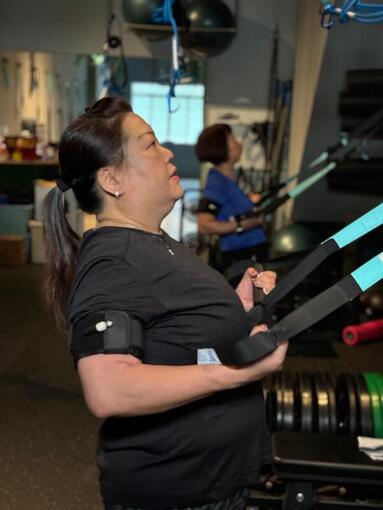
The short answer is no: osteoporosis is more serious, & the difference changes the treatment your doctor suggests. But don't shrug osteopenia off. So many more women have it that a large share of fractures happen in this range. It's the window to act, while your bones respond well & you can train freely.
From scan to plan: what's safe at each stage
Osteopenia: build bone now
- Strength training 2-3 times a week: squats to a chair, step-ups, rows, presses & hip hinges, heavy enough that the last 2 reps of 8-12 feel hard.
- Impact most days: 20-50 heel drops or small hops, if your joints allow. Brisk walking is good for you, but on its own does little for bone density.
- Balance daily: stand on one leg near the kitchen counter, 30 seconds each side.

Osteoporosis without fractures: train smart
You can still get stronger, & you should. Keep resistance training 2-3 times a week, progress the load gradually & keep your back long. Many patients also take medication; exercise works alongside it. Add back-strengthening moves, daily balance work & gentle impact such as heel drops if your doctor agrees. Avoid sit-ups, toe touches, deep forward folds & twists, & lifting with a rounded back.
After a spinal fracture: guided only
Get your doctor's clearance first, then start with supervised strength, posture & balance work, at a pace your body accepts.
| Exercise | Sets & reps | Easier | Harder | What it should feel like |
|---|---|---|---|---|
| Sit-to-stand | 2 x 8-10 | Higher chair, hands on thighs | Hold a bag of rice at your chest | Thighs & bottom working, no pain |
| Wall push-up | 2 x 10 | Feet closer to the wall | Kitchen-counter push-up | Chest & arms working |
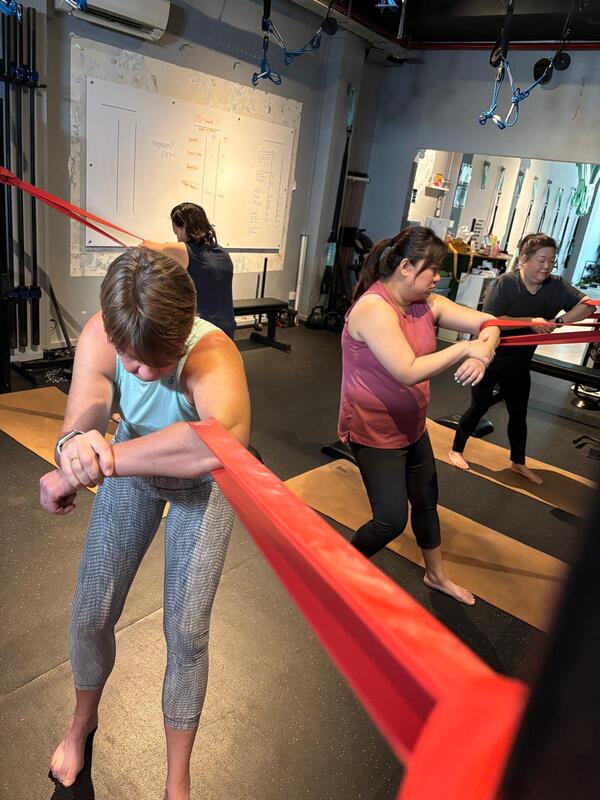
| Band row | 2 x 12 | Lighter band | Pause 2 seconds | Squeeze between the shoulder blades |
| Heel drops | 1-2 x 20 | Hold the counter | Small hops | A light jolt through the heels, never pain |
| Single-leg stand | 3 x 30 seconds | Fingertip on the counter | Eyes closed (osteopenia only) | Steady, a little wobble |
Eating for bone health in Singapore
Calcium-set tofu, ikan bilis eaten with the bones, sardines, milk or calcium-fortified soy milk & leafy greens are easy calcium sources. Vitamin D comes mostly from the sun, yet many of us stay indoors, so ask your doctor about a vitamin D test. Bananas are a healthy snack, but not a calcium source.
Red flags: see a doctor first
- Sudden back pain after a minor bump, cough or lift.
- Losing height, or a back that rounds more each year.
- A fall that caused a fracture, or more than one fall this year.
- A Z-score of -2.0 or below, or bone loss at a young age.
What to do this week
- Find your report & note your lowest T-score & the site it was measured at.
- Ask your doctor about treatment, a vitamin D test or a FRAX estimate.
- Do the 5 exercises above on 2 non-consecutive days.
- Practise balance daily while you brush your teeth.
- Make your flat fall-safe: clear loose mats & light the path to the toilet at night.
When you want someone to guide you
A result like this can feel frightening, especially if you watched your mother go through a broken hip. The best way through is a clear plan & someone watching your technique. At MSMC, our sports medicine trainers are personal trainers trained in movement science & exercise for health conditions, so they know how to load bones safely. We start with a $190 full assessment of strength, balance & how you move, then build a plan around your results & your doctor's advice. We test, we don't guess. We don't diagnose or prescribe; we work alongside your doctor.
See personal training & the $190 assessment
Prefer to train with other women? Our small classes include strength & balance work. Use READ10 for 10% off one class: book on our class schedule page & enter READ10 at checkout (one use per customer). Sore knees too? See our knee osteoarthritis exercises for elderly people.
Scared to start? Here's exactly what happens next
- Bring your report, or just tell us your T-score. No pressure to buy anything.
- We ask about red flags, past falls & your doctor's advice first.
- Your assessment: gentle tests of strength, balance & posture, explained in plain words.
- A plan you understand: which exercises suit you, which to skip, & how to get up from the floor safely.
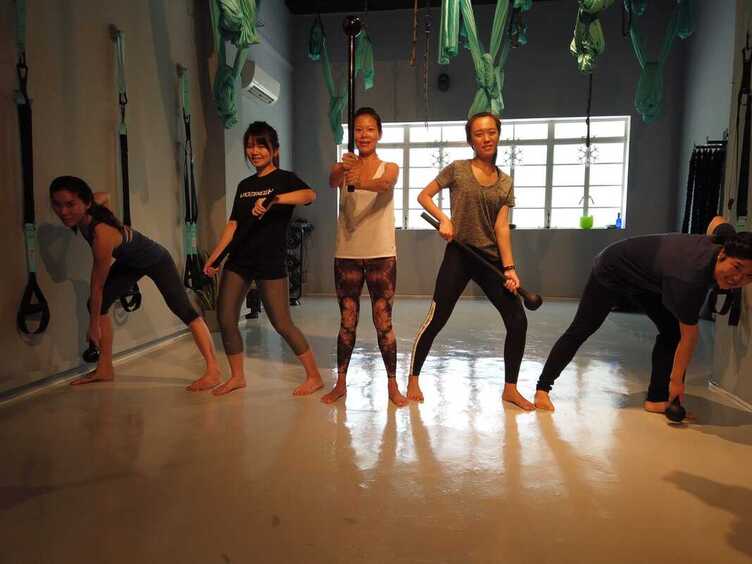
- Training at your pace, one-to-one or in a small class. You never lift anything you're not ready for. See what your first session after 50 looks like.
Osteopenia & osteoporosis: FAQs
Am I allowed to exercise with osteopenia or osteoporosis?
Yes. For most women, strength, impact & balance exercise is recommended. Choose moves that suit your stage, avoid loaded bending & twisting if your spine is affected, & get your doctor's clearance first if you've had a fracture.
Can exercise stop me breaking a hip like my mother?
No one can promise that, but stronger legs & better balance lower your risk of falling, & most hip fractures follow a fall. That's why balance training sits alongside strength work.
How is osteopenia diagnosed?
Bone density is measured with a DEXA scan of the hip & back. A T-score between -1.0 & -2.5 means osteopenia. Your doctor reads it alongside your age & other risks.
Can osteopenia be reversed?
Some women improve bone density, & many slow bone loss, with strength & impact training, enough calcium & vitamin D, & sometimes medication. Results vary, so repeat scans with your doctor.
Does walking improve osteopenia?
Walking helps your heart, balance & mood, but on its own does little for bone density. Add strength training 2-3 times a week & some impact.
Are bananas good for osteopenia?
They're healthy, but low in calcium. Tofu, ikan bilis, sardines, milk & greens do more for bone health. If you have a question about your own result, ask your physician.