
If your knees ache on the MRT stairs & when you get up from a chair, & the doctor called it "wear & tear", the best knee osteoarthritis exercises for elderly people are simple strengthening moves you can do at home with a sturdy chair & a towel, 3 times a week. Strong thighs & hips take load off the joint, which is why exercise is a first-line treatment for knee osteoarthritis in medical guidelines. Below is a 20-minute routine for your flat, & a step-by-step path back to climbing MRT stairs without holding the handrail.
Last updated: 26 November 2026. Written by the team at MSMC (Movement & Sports Medicine Centre), a sports medicine personal training studio at Farrer Park, Singapore.
Key facts: knee osteoarthritis exercises for elderly people
- Exercise is safe for most older adults with knee osteoarthritis, & one of the most effective ways to reduce knee pain & improve how you move.
- "Wear & tear" doesn't mean your knee is finished: strong muscles can share the load.
- Muscle strength matters most: focus on the quadriceps (front of thigh), hips, glutes & calves, 2-3 times a week.
- Mild discomfort (up to about 3 out of 10) that settles by the next morning is usually fine.
- A hot, very swollen knee, a knee that locks or gives way, or pain after a fall needs a doctor first.
- Low-impact cardio, such as walking, cycling or swimming, helps the joints & the heart.
"Wear & tear": what knee osteoarthritis really means
Osteoarthritis is the most common type of arthritis. The smooth cartilage at the ends of the thigh & shin bones slowly thins, the joint lining can get irritated, & the knee becomes stiff & sore, especially on stairs, getting up from a chair or after sitting through a long meal. It's linked to age, past knee injuries, body weight & genes. X-ray changes don't always match how much it hurts: many people with "bad" X-rays still walk, travel & play with their grandchildren, because strong thigh muscles share the load.
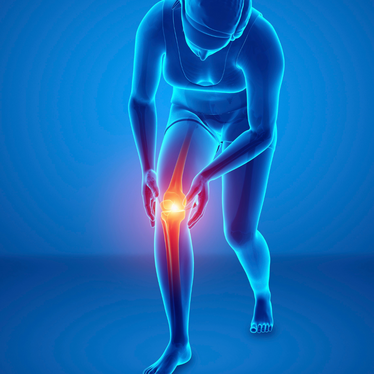
Does it have to end in a knee replacement?
Not necessarily. Many people with knee osteoarthritis manage well for years with exercise, a healthy weight & the right pain relief, & some never need surgery. For others, surgery becomes the right choice, & that's a decision for you & your orthopaedic doctor. Either way, stronger legs help: people who go into a knee replacement stronger often find the recovery easier.
A 30-second self-check before you start
Sit on a firm dining chair, arms crossed over your chest, & count how many times you can stand up & sit down in 30 seconds. Write the number down. Many active adults over 65 manage around 12 or more; fewer than 8 suggests your leg muscles need strengthening before stairs feel easy. With knee osteoarthritis, it's not a test to pass or fail. It's your starting point, & you can repeat it every 2 weeks to see progress.
| Your 30-second number | Where to start | Your stair goal for now |
|---|---|---|
| Under 8 | Level 1 below, hands on the chair for support | Stairs with both hands on the rail |
| 8 to 12 | Level 1, then add Level 2 after 2 weeks | Stairs with one hand on the rail |
| Over 12 | Levels 1 & 2, then Level 3 | MRT stairs with a fingertip, then no hand |
The chair & towel routine for your flat (20 minutes, 3 times a week)
Do these exercises on Monday, Thursday & Saturday, or any 3 days with a rest day between. Wear shoes or go barefoot on a non-slip floor, & place the chair against a wall so it can't slide. A dining chair & a bath towel are all you need.
Level 1: build strength
- Towel squeeze (quad set): 10 reps, 5-second hold. Sit on the floor or bed with legs straight & a rolled towel under the sore knee. Push the back of the knee down into the towel & tighten the front of your thigh. Feel: the front of the thigh working hard. Easier: hold 3 seconds. Harder: hold 10 seconds.
- Seated knee straightening: 2 x 10 each leg. Sit tall, keep one knee bent & foot on the ground, straighten the other leg slowly, hold 3 seconds, then slowly lower. Harder: loop a tote bag with a 1 kg bag of rice over the ankle.
- Sit-to-stand: 2 x 8. Stand up from the seat, squeezing your glutes at the top, then sit back down slowly. Easier: add a cushion to make the chair higher, or push from your thighs. Harder: arms crossed & take 3 seconds to sit. Grandparent version: hold a 3-5 kg bag of rice at your chest, about the weight of carrying a toddler for a moment.
- Towel heel slide: 10 each leg. Lying or sitting with a towel under your heel, slide the heel towards you to bend the knee as far as is comfortable, then slide it back. Feel: a gentle stretch, not a sharp pain.
- Side leg lift holding the chair back: 2 x 10 each side. Stand tall, lift your right leg out to the side, slowly lower & repeat, then switch to the left leg. This strengthens the hips & glutes, which keep the knee in line.
- Heel raises holding the kitchen counter: 2 x 12. Rise onto your toes, then slowly lower your heels. This builds the calf muscles that help you push up each step.
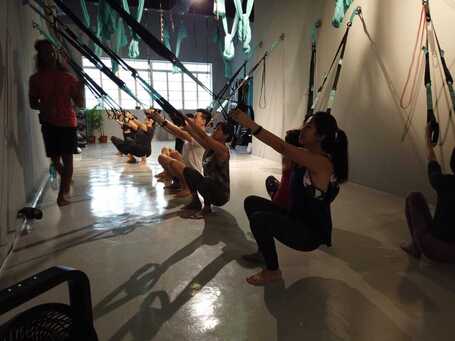
Level 2: add step & balance exercises (from week 3)
- Step-ups on the bottom stair of your block or a sturdy low step: 2 x 8 each leg. Hold the rail. Step up with the sore leg, then lower with the good leg, slowly.
- One-leg balance holding the counter: 3 x 20 seconds on each foot. Stand on one foot with the other knee bent. Harder: one fingertip only.
Other exercises: calf stretch & hamstring stretch
- Calf stretch: two sets of 30 seconds each side. Face the kitchen counter with your hands on it, step your right foot back, keep that leg straight & the heel on the ground, & lean forward until you feel the calf stretch. Repeat with the left leg.
- Hamstring stretch: two sets of 30 seconds each side. Sit on the front edge of a seat with one leg straight & the heel on the floor, then lean forward from the hips until you feel the back of the thigh stretch. Good flexibility here makes straightening the knee easier.
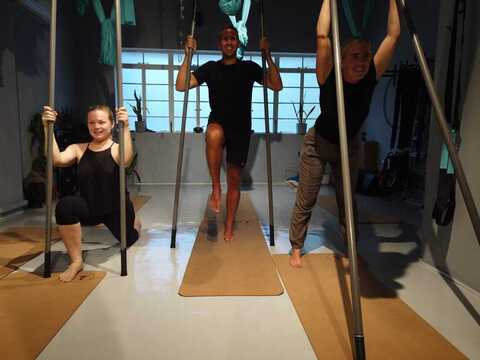
Level 3: back to MRT stairs without the handrail
Once you can do 2 x 8 step-ups each leg holding the rail with little or no pain, climb one flight of your HDB staircase with a light hand on the rail, 2-3 times. Next, use just a fingertip. Then try one flight without holding on, the rail still within reach. When that feels steady for a week, try a short flight of MRT stairs the same way, outside rush hour. Going down is usually harder than going up, so take the down steps one at a time if you need to. There's no rush: the rail & the lift are always there.
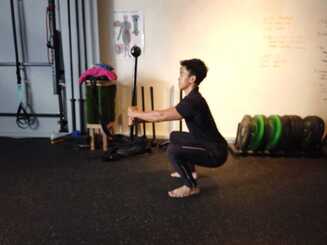
How much pain is OK during knee osteoarthritis exercises?
A little is normal, a lot is a signal. A good sign that the routine suits you: stairs & getting up from a seat feel a bit easier each week. Use a 0-10 scale: discomfort up to about 3 that settles by the next morning is generally fine. If pain goes above 5, or the knee is more swollen & stiff the next day, make the exercise easier next time (fewer reps, a higher chair, a smaller bend) rather than stopping altogether.
Which exercises help knee osteoarthritis most?
| Type of exercise | What it does for knee osteoarthritis | How often | Watch out for |
|---|---|---|---|
| Strengthening (the routine above) | Builds the muscles that protect the joint & ease knee pain | 2-3 times a week | Pain above 5 out of 10 |
| Walking | Everyday physical activity that keeps the joint moving & gets you ready for holidays | Most days, 10-30 minutes | Long downhill walks early on |
| Cycling or a stationary bike | Low-impact cardio with a smooth knee bend | 2-3 times a week | Saddle too low |
| Swimming or water walking | Takes body weight off the knees | Any day you like | Slippery pool decks |
| Gentle stretching | Keeps the knee straightening & bending fully | Daily, a few minutes | Bouncing into a stretch |
| Running & jumping | Not needed to start; some people return to it later with guidance | Only once strong & pain is settled | Flare-ups |
In Singapore's heat, walk early in the morning or in the evening, or loop an air-conditioned mall or the void deck on rainy days.
What to avoid with knee osteoarthritis
- Long periods of sitting without moving, like a long mahjong session or TV evening: stiffness builds. Stand up every 30-45 minutes.
- Deep squatting into pain, kneeling on hard floors & sudden twisting on a planted foot.
- Doing nothing. Rest during a flare is fine for a day or two, but too much rest weakens the legs further.
- Pushing through sharp pain to "earn" the result.
Red flags: see a doctor first
- A knee that is hot, red & very swollen, or you have a fever.
- The knee locks, catches or gives way repeatedly.
- You can't put weight on the leg, or pain started after a fall.
- Calf pain & swelling, especially after a long flight or surgery.
- Night pain that wakes you & doesn't ease.
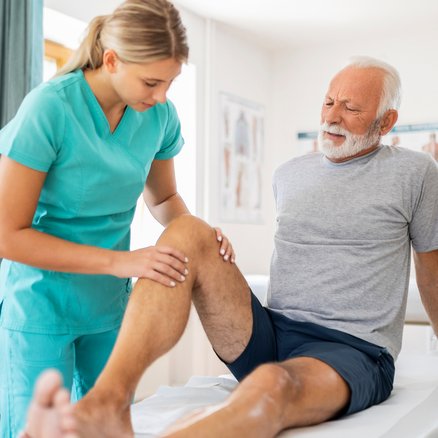
Your first week
- Day 1: do the 30-second chair test & write down your number.
- Days 1, 4 & 6: the Level 1 routine (20 minutes).
- Every day: a 10-15 minute walk, & stand up from your chair without using your hands 5 times.
- Every evening: note your knee pain out of 10. If it's steady or better, keep going.
- Day 7: if the routine feels easy, add 2 reps to each exercise next week.
Reading this for your mum or dad?
If you're searching for a parent, the most useful thing you can do is the chair test together, then help them start the routine 3 times a week. Watch for the red flags above, & go with them to the doctor if any appear. If they'd rather be guided by someone else, the next section is for you both.
When you'd like someone to guide you
Some people are happy on their own. Others want someone to check their technique, especially if one knee is much worse or they've had a fall. That's what our sports medicine trainers do. They are personal trainers trained in movement science & exercise for health conditions such as osteoarthritis. We start with a $190 full assessment: we test strength, balance & how you climb a step, then build a plan around your daily life, from your block's stairs to the MRT & your next holiday. We test, we don't guess. We don't offer physiotherapy; many of our members come to us after physio to keep building strength. Bone health matters too, so see osteopenia vs osteoporosis if you've had a bone scan.
See personal training & the $190 assessment
Prefer company? Our small classes include strength, balance & general fitness work at an easy pace. Use READ10 for 10% off one class: book on our class schedule page & enter READ10 at checkout (one use per customer).
Worried your knees are "finished"? Here's what happens next
That fear is very common after hearing "wear & tear". Here is what happens if you come to us:
- You message or book, or your son or daughter does it for you. No pressure to buy anything.
- We check for red flags first & tell you honestly if a doctor should see the knee before we train you.
- Your assessment: chair stands, steps & balance, explained in plain words.
- You learn a short home routine you can follow, with pictures if you like.
- Training at your pace, one-to-one or in a small class, with real-life goals: the MRT stairs, a walking holiday, lifting your grandchild.
Knee osteoarthritis exercises: FAQs
What works for arthritis knee pain?
For most people, regular strengthening exercises, staying active, keeping a healthy weight & pain relief advised by a doctor or pharmacist when needed. Exercise is a core part of treatment, not an extra.
Will I need a knee replacement?
Not everyone does. Many people manage knee osteoarthritis with exercise & weight control for years. Your orthopaedic doctor can tell you if surgery makes sense for you, & being stronger helps either way.
Should I avoid stairs if I have knee osteoarthritis?
Not usually. Stairs are good training once your thigh muscles are stronger. Use the rail at first & build up with step-ups at home.
Is walking good for knee osteoarthritis?
Yes. Walking keeps the joint moving & helps your weight & heart. Start with 10-15 minutes on flat ground & build up.
How long before knee exercises help?
Many people notice easier stairs & less stiffness after 6-8 weeks of exercising 2-3 times a week. Everyone is different, so track your chair test every 2 weeks.
Can exercise make knee osteoarthritis worse?
Sensible exercises don't wear a knee with osteoarthritis out faster. A short flare after doing too much can happen; make the next session easier & build up more slowly.