
Aerial stretching (Singapore studios also call it hammock stretching) is a stretch class where a soft fabric hammock, hung from the ceiling, holds part of your body weight while you stretch, so your muscles can let go more easily & you can move into positions that are hard to reach on the ground. In Singapore, MSMC (Movement & Sports Medicine Centre) runs its Aerial Stretch class at 151A Kitchener Road, a short walk from Farrer Park MRT, for adults who feel stiff, sit a lot or simply want to move more freely. You don't need to be flexible, strong or sporty to start, & no aerial experience is needed: it's beginner friendly, welcomes absolute beginners & every position can be made easier.
Aerial stretching in Singapore: key facts
- What it is: a 55-minute group stretch class using a soft aerial hammock to support your body while you stretch, breathe & move.
- Who it's for: beginners & adults of most ages who feel stiff or tight, from desk workers to active people who want better mobility. No flexibility needed.
- Price (as of November 2026): $45 per class, or included in a membership: Pro $300 a month (12 classes) or ELITE $369 a month (unlimited classes), both on 6-month terms.
- Class size: a maximum of 9 students, so the instructor can see & help everyone. Beginner friendly & open to all levels.
- Who teaches it: MSMC's sports medicine trained (SMT) trainers.
- Where: MSMC, 151A Kitchener Road #02, Singapore 208526, near Farrer Park MRT.
- How to book: on Momence through our Aerial Stretch class page, or on WhatsApp at +65 8973 7619. Classes are appointment based; we're closed on Sundays & public holidays.
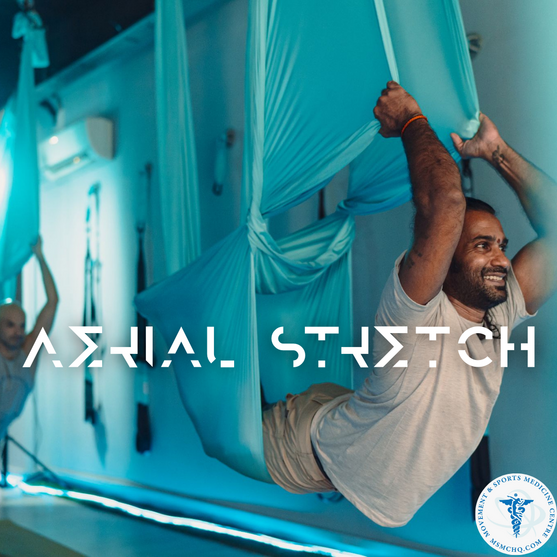
What is aerial stretching?
Aerial stretching uses a soft fabric hammock: a long piece of fabric hung from two points in the ceiling, usually set around hip height. Instead of holding all of your body weight on the ground, you lean, sit or lie in the fabric. The aerial hammock works like a support system, taking some of the load so you can relax into the position rather than fight to hold it. In some positions you're fully supported, with your hips or legs in the air.
At MSMC, our Aerial Stretch class is built on sports medicine & mobility principles rather than performance tricks. A class mixes slow, guided breathing, supported stretches, simple strength & balance work, & gentle decompression positions where the hammock lets your spine & hips lengthen. We follow the same idea as everything else we do: we test, we don't guess, so the instructor watches how you move & adjusts the stretch to your body. It's a sports medicine approach, with close guidance on biomechanics, alignment, positioning & joint safety. Each session also uses breathing & a little mindfulness to help you settle; slow breathing is a simple but powerful way to help your body let go.
How does the aerial hammock help you stretch?
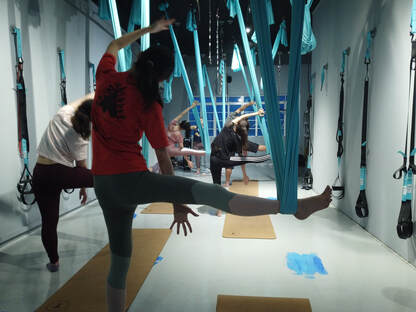
The hammock changes three things compared with stretching on a mat:
- Support. When the fabric holds a leg, your hips or your trunk, the muscles around that area don't have to work as hard to keep you steady. Muscles that feel safe tend to relax more, which can make each position feel easier & deeper.
- Gentle traction. Hanging or leaning into the hammock lets gravity gently pull the body & spine long. Many people find this gives a sense of "space" in the lower back, hips or shoulders, which is hard to get on the ground.
- Balance & control. The fabric moves a little in the air, so the small stabilising muscles around your joints switch on & your balance gets a gentle workout. That's why aerial stretching can build body awareness & control, not just flexibility.
For a closer look at how this compares with floor stretching, read our guide to aerial stretching vs normal stretching.
Is aerial stretching the same as aerial yoga?
Not quite. Both use the same kind of hammock, but the goal is different. Aerial yoga classes in Singapore usually follow yoga poses (asanas) in flowing movements, often with time for mindfulness or meditation, much like traditional yoga on the mat. If you already practise traditional yoga, aerial yoga will feel familiar, & if you search for aerial yoga Singapore studios, you'll find many offer it. Aerial stretching is focused on mobility: which muscles & joints feel tight, & how to help them move better. At MSMC our aerial stretch work uses techniques from sports medicine, such as contract-relax (PNF) stretching & breathing to help muscles let go.
| Aerial stretching (MSMC) | Aerial yoga | Aerial fitness, silks or hoop | |
|---|---|---|---|
| Main goal | Flexibility, mobility, body awareness & feeling less stiff | Yoga postures, flow & mindfulness | Strength, conditioning or acrobatic skills |
| How it's taught | Supported stretches, contract-relax (PNF), breathing, gentle decompression | Yoga poses adapted to the hammock | Climbs, wraps, holds & drops |
| Upside-down positions | Optional & gentle, only if right for you | Often part of class | Often a big part of class |
| Strength needed to start | Very little | Some | More, especially upper body & grip |
| Best for | Stiff beginners, desk workers, adults 35 to 60s, active people wanting better range | People who enjoy yoga & want to try the hammock | People who want a challenge or to learn aerial skills |
If you've enjoyed aerial yoga before, you'll find the hammock familiar, but an aerial stretch class will feel slower & more focused on how your body moves.
Which suits you: aerial yoga classes vs aerial stretch?
- Choose aerial yoga if you enjoy yoga poses, flowing movements & a bit more challenge. An existing yoga practice helps, & aerial yoga can be a fun workout as you build balance in the air.
- Choose an aerial stretch class if you feel stiff, are new to exercise or want to improve mobility & ease tension in your hips, back & spine. The pace is slower & the instructor adjusts each stretch to your body.
- Try both if you like variety & want to discover what suits you. Many people use aerial yoga for fun & challenge, & aerial stretch for enhancing flexibility & movement quality.
What other aerial classes are there, like aerial hoop & aerial pilates?
Many aerial classes in Singapore use a different aerial apparatus or goal. Aerial yoga uses the hammock for yoga poses. Aerial pilates uses it for pilates-style core work. Aerial hoop (lyra) & aerial silks lean towards aerial arts, aerial acrobatics & performance (aerial arts classes are a big challenge & a full workout), with more climbing, upper body strength & skill. Aerial fitness classes use the hammock for conditioning. MSMC's Aerial Stretch class sits at the gentle end: the focus is improving mobility & enhancing flexibility, not tricks.
Is aerial yoga a workout or a stretch?
Both. Aerial yoga mixes yoga poses, balance work & some strength, so most aerial yoga classes feel like a gentle workout & a stretch in one. How hard it feels depends on the poses & how many inversions the class includes. An aerial stretch class is more stretch than workout: the poses are simpler & held longer, with more support, so most beginners find it easier than a mat-based yoga class, while aerial yoga can be harder than normal yoga when it adds inversions.
What are the benefits of aerial stretching for flexibility, core strength & balance?
Here are the aerial stretching benefits people tend to notice, kept honest:
- Greater flexibility & range of motion. Regular stretching can improve how far your joints move, which many people feel as more freedom in everyday movement. The NHS recommends flexibility exercises as part of staying active, & notes they help you move more freely.
- Feeling less stiff after sitting. Long hours at a desk or in the car can leave hips, hamstrings, the neck, upper back, lower back & shoulders feeling tight. Supported positions on & off the ground make these areas easier to reach.
- A deeper stretch with less strain. Contract-relax (PNF) stretching, where you gently push against a stretch & then relax into it, has been shown in research to improve range of motion, often more than simply holding a stretch (Hindle et al., Journal of Human Kinetics, 2012). The hammock gives you something to push against.
- Balance, control & core work. Because the fabric moves, your body has to stay steady, so balance improves with practice. Balance work matters more as we age: the World Health Organization advises older adults to include balance & strength activities to help prevent falls.
- Calm, relaxation & stress relief. Slow breathing & supported positions help many people release tension & leave with a deep sense of calm. It isn't a treatment for mental health conditions, but a calm hour of movement is good for most of us.
- Body awareness & confidence. You discover where you hold tension & how to let it go, which can help you notice your posture & how you sit & stand. Many people also enjoy the confidence that comes from trying something new & exploring movement in the air, & find it fun.
- Some core strength & upper body work. Holding the fabric & keeping steady asks your core, arms & the small muscles around your spine to work.
What stretching doesn't do: according to a 2025 consensus of international stretching researchers, it reliably improves range of motion, but on its own it doesn't lower overall injury risk, isn't a strong recovery tool & doesn't change posture much. Flexibility builds over weeks of regular practice, so aerial stretching works best alongside strength work as part of your fitness journey.
Can aerial stretching build strength?
A little. You'll use your core, grip & upper body to stay steady, & supported holds build some functional strength, core strength & control. But aerial stretching won't build upper body or leg strength the way strength training does, so if you want to build strength for daily life, pair it with a strength class or personal training. Think of aerial stretch as a powerful way to move better, & strength work as the way to build strength.
Can aerial stretching improve posture?
Not on its own. Stretching alone doesn't improve posture much, according to research, but it can make positions like sitting tall or standing straight feel easier because your hips, chest & spine move more freely. To improve posture in a lasting way, combine aerial stretch with strength work for your back & trunk, & with simple habits like moving more often during long hours at a desk.
Who is aerial stretching for?
Most adults can join an aerial stretch class. It tends to suit:
- beginners who feel too stiff for a normal yoga or stretch class
- office workers with tight hips, a stiff back, neck or shoulders
- adults in their 40s, 50s & 60s who want to keep moving well
- runners, golfers, cyclists, gym-goers & people who do pilates or yoga & want better mobility
- anyone who wants a gentle, calm, fun way to explore movement that still feels like a workout
It isn't only for women or dancers: men & women of all shapes & sizes join, & Singapore's heat & rain don't matter because it's indoors.
Is aerial stretch beginner friendly if I'm not flexible or strong?
Yes. Flexibility is what you build in class, not what you need to start, & first timers are welcome. Positions can be made smaller, the hammock can be set at a different height & your feet can stay on the ground whenever you like. Our trainers modify every move to your comfort level, so aerial stretching for beginners is about control & steady progress, not perfect poses. You start with low-intensity, supported positions & basic techniques, then build up gradually, at your own pace, over the weeks. Each session is a small step in your journey, & the challenge grows as your confidence & balance do.
Is aerial stretching good for weight loss?
It's not the main purpose. An aerial stretch class uses some energy & works your core & balance, but weight loss mostly comes from what you eat plus regular activity such as brisk walking & strength work. For cardiovascular health, the WHO recommends 150 to 300 minutes of moderate activity a week.
How old do you have to be for aerial stretching?
Our Aerial Stretch class is designed for adults, & most people who train at MSMC are in their mid-30s to 60s. There's no upper age limit: for most healthy adults over 50 it's safe when matched to your fitness level, with upside-down positions always optional. Mention osteoporosis or a joint replacement before class. For anyone under 18, ask us on WhatsApp first.
Why do aerial stretching at Movement & Sports Medicine Centre?
- Experienced instructors who are sports medicine trained (SMT) & focus on alignment, joint safety & how your body moves, not tricks.
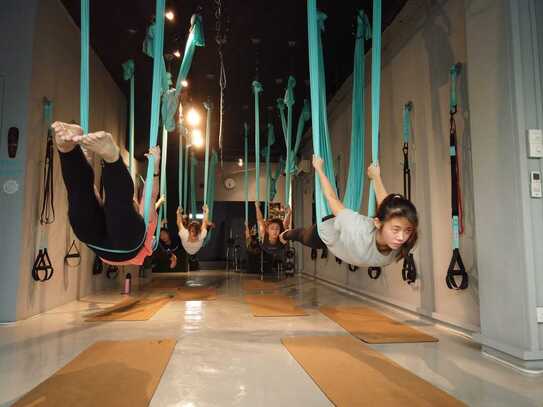
- Small groups of up to 9 students in our Kitchener Road studio, near Farrer Park MRT, so everyone gets personalised guidance.
- Part of a bigger plan: if you have pain, we start with a full assessment ($190) & can combine classes with personal training or one-to-one stretch therapy (see what happens in an F.S.T session). We work alongside physiotherapists & doctors.
Whichever aerial studio you choose, it's fair to ask how the instructors are trained, how big the classes are & how often the rigging & fabric are checked.
Who should check with a doctor before aerial yoga or aerial stretching?
Please see a doctor first, & tell your trainer before class, if any of these apply to you:
- you are pregnant or have recently given birth
- high blood pressure that isn't controlled, heart disease, or a history of stroke
- glaucoma, a detached retina or recent eye surgery: head-down positions raise eye pressure, which research has shown even in common yoga poses (Jasien et al., PLOS ONE, 2015)
- recent surgery, a recent injury, or a joint replacement
- severe osteoporosis, vertigo or a recent head injury
- pain that is severe, getting worse, wakes you at night, or comes with numbness, weakness, fever or unexplained weight loss
The same applies to aerial yoga classes & other aerial classes. Many of these don't mean you can never do aerial stretching: often it just means no upside-down work, or a different starting point. MSMC doesn't diagnose; we work alongside physiotherapists & doctors. If you have pain, the best first step is our $190 full assessment, so we can check how you move & suggest the right class or plan.
What is your first aerial stretch class like?
A first class is calm & well guided by experienced instructors, & it's a fun way to start your aerial journey & explore movement in the air. A session usually runs like this:
- Arrive a little early & settle in. Tell the instructor about any aches, injuries or health conditions, & whether you're new. Take off any jewellery.
- Getting to know the hammock. The instructor sets the hammocks to the right height for each person & shows you how to sit, lean & hold the fabric safely. Learning to trust it is the first step.
- Warm-up & breathing. Gentle movement on the ground & slow breathing to warm the joints & settle the body.
- Supported positions. Hips, hamstrings, back, chest & shoulders, using the hammock to hold part of your weight. You'll use contract-relax: push gently for a few seconds, breathe out, then relax a little deeper.
- Balance, stability & control. Simple standing & supported moves that ask for deeper engagement from your core & stabiliser muscles, while the instructor checks your alignment.
- Decompression (optional). Gentle positions where the hammock acts as a support system & lets the spine lengthen. Going upside down is your choice & only offered when it suits you.
- Wind-down. A few quiet minutes resting in the fabric, a little like the rest at the end of a yoga class or a short meditation, then a check on how you feel after the session.

With a maximum of 9 students, the instructor can watch your position & adjust it. It's normal to feel the fabric press on your hips or legs the first time; that eases as you get used to it. Every position should feel strong but never painful, so say if something doesn't feel right. By your next class, most people already feel more at home in the hammock & discover positions they couldn't reach on the ground.
What to wear: aerial stretching clothes checklist
- Long leggings or fitted long pants, so the fabric doesn't rub the backs of your knees or your legs.
- A fitted top that covers your underarms, so it doesn't slide up when you lean back or go upside down.
- No zips, buttons, belts or jewellery, including rings & watches, which can snag or tear the fabric.
- Bare feet or grip socks.
- Avoid lotion on your arms & legs before class, as it makes the fabric slippery.
- Have a light meal 1 to 2 hours before rather than a big meal just before class, especially if you plan to try upside-down positions, & bring water.
How much does an aerial stretch class cost in Singapore?
At MSMC, as of November 2026:
| Option | Price | What you get | Best if |
|---|---|---|---|
| Single class | $45 | One 55-minute Aerial Stretch class (max 9 students) | You want to try it first |
| Pro membership | $300 a month (6-month term) | 12 classes a month | You'll come about 3 times a week |
| ELITE membership | $369 a month for sign-ups this year (listed $399), 6-month term | Unlimited classes, 2 guest passes & one 30-minute F.S.T (Functional Stretch Therapy) a month | You want aerial, other stretch classes & one-to-one stretch therapy |
With a membership you can mix Aerial Stretch with other MSMC classes, such as Stretch Mob, Bandit Stretch, Deep Roll 2.0 (foam rolling), BFRT, Barbell Lifting & Breathera Breathworks.
Why is hot yoga so expensive, & why do aerial classes cost more than a mat class?
Studios price classes around what they cost to run. Hot yoga needs a heated room & the energy to keep it warm, while aerial classes need ceiling rigging, hammocks that are checked & replaced, & smaller groups, because each person needs their own rig & more of the instructor's attention. That's why aerial classes in Singapore usually cost more than a mat class, & why our Aerial Stretch class is capped at 9 students.
Can I join drop in classes, or do I need a membership?
You can drop in for $45 a class, which is the easiest way to try your first aerial stretch class. Many aerial yoga studios in Singapore offer drop-ins too. If you come every week, a membership usually works out better: Pro gives you 12 classes a month, & ELITE gives you unlimited classes.
How often should I do aerial stretching to reach my fitness goals?
For most people, once or twice a week is a good start, whatever your fitness goals & wherever you are on your fitness journey. Flexibility tends to improve with regular practice over several weeks, & a few minutes of self practice at home between classes helps you improve mobility. Consistent practice matters more than any single session, & the fitness benefits build over time. Singapore's Health Promotion Board encourages adults to stay active through the week & to include muscle-strengthening activities, so aerial stretching sits well next to walking or a strength workout rather than replacing them.
Where can I exercise for free in Singapore?
Plenty of options are free: park connectors & nature parks for walking or running, & the fitness corners found in many parks & HDB estates. They're great for staying active between classes; a supported stretch class adds the coaching that's hard to get on your own.
Aerial stretching FAQs
Is aerial yoga hard for beginners?
Not usually, though aerial yoga can feel harder than aerial stretching because it adds more poses & inversions. Aerial stretching for beginners starts with simple, supported positions with your feet on or near the floor. You don't need any flexibility, strength or experience, & upside-down positions are optional. Many aerial yoga classes also have beginner levels; ask the studio which suits you.
Is aerial yoga good for stretching?
Yes, aerial yoga includes many stretches, & the hammock helps you hold them. If stretching & mobility are your main goal, an aerial stretch class is more focused on that than an aerial yoga class.
Do you have to go upside down in aerial stretching?
No. Inversions are always optional at MSMC & only offered when they suit you. People with glaucoma, uncontrolled high blood pressure, heart conditions or pregnancy should avoid them unless their doctor says otherwise.
Does aerial stretching hurt?
It shouldn't. The fabric can feel firm against your hips or legs the first time, & a good position feels strong, but it should never be painful. Tell the instructor if anything hurts so they can change the position.
How much does an aerial yoga class cost in Singapore?
Prices vary from studio to studio, so check the drop in price, class size & membership terms before you sign up. At MSMC, a single 55-minute Aerial Stretch class is $45 as of November 2026, or classes are included in the Pro ($300 a month, 12 classes) & ELITE ($369 a month, unlimited classes) memberships on 6-month terms.
Where can I do aerial stretching in Singapore?
For aerial stretch Singapore classes, MSMC runs Aerial Stretch at 151A Kitchener Road #02, Singapore 208526, a short walk from Farrer Park MRT. Book on Momence or WhatsApp +65 8973 7619. MSMC doesn't run aerial yoga; if aerial yoga is what you're after, look for a studio that specialises in aerial yoga.
Last updated: 21 November 2026. Written by the MSMC team & reviewed by a sports medicine trained trainer.
Start your fitness journey: book your first aerial stretch class
If you'd like to try it, book an Aerial Stretch class on Momence through our Aerial Stretch class page, or message us on WhatsApp at +65 8973 7619 & we'll help you pick a time for your next class. If you have pain or an injury, start with our $190 full assessment so we can check how you move first. We're at 151A Kitchener Road, near Farrer Park MRT.