
Aerial stretching vs stretching on the floor: the main difference is support. In aerial stretching, a soft fabric hammock suspended from the ceiling holds part of your body weight, so your muscles can relax & you can reach positions that are hard to hold on the floor. In normal stretching, your own body, balance & strength hold each position. Neither is better for everyone: at MSMC (Movement & Sports Medicine Centre) on Kitchener Road, near Farrer Park MRT, we use both, plus one-to-one assisted stretching, & the right choice depends on your body & goals.
Aerial vs normal stretching: key facts
- Aerial stretching: an aerial hammock suspended from the ceiling supports part of your body weight. Good for stiff beginners, gentle spinal decompression & balance.
- Normal stretching: on a mat, a wall or sitting on a chair. Free, simple, accessible at all fitness levels & easy to do every day, with no equipment.
- Assisted stretching: a trainer stretches you one-to-one. At MSMC this is F.S.T (Functional Stretch Therapy).
- Price at MSMC (as of November 2026): $45 per 55-minute class (Aerial Stretch, Stretch Mob or Bandit Stretch); Pro $300 a month (12 classes); ELITE $369 a month (unlimited classes plus one 30-minute F.S.T a month).
- Class size: Aerial Stretch & Stretch Mob up to 9 participants; Bandit Stretch up to 6.
- Where & how to book: 151A Kitchener Road #02, Singapore 208526. Book on Momence or WhatsApp +65 8973 7619.
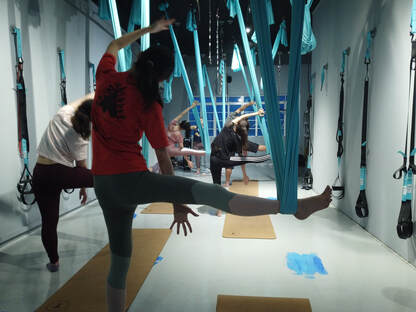
What does the aerial hammock change?
On the floor, part of your effort goes into balancing & holding the position. If muscles feel unsafe, your nervous system adds tension to protect you, which is one reason a stretch can feel stuck. Hammock stretching changes that in four ways, whether you're in an aerial yoga class or an aerial stretch class:
- It takes some of your body weight. The fabric holds a leg, your hips or your trunk, so muscles around the stretch can relax. Many people can hold deeper stretches for longer & breathe more easily, with less pressure on the knees, wrists & feet.
- It adds gentle traction. Hanging or leaning in the hammock lets gravity lengthen the body. Many people feel space in the lower back, hips & spine, which is what people mean by gentle spinal decompression; the aerial hammock lets the body & spine hang long. It's a feeling of relief, not a medical treatment.
- It adds balance & coordination. The hammock moves a little, so your core muscles & the small muscles around your joints engage & strengthen as they keep you steady, which makes it a gentle workout too. Many people also notice better body awareness & a stronger mind body connection, because you have to sense where you are in the air.
- It gives you resistance to push against. That makes PNF stretching (contract-relax) easy to do, which research shows can improve range of motion, often more than holding a stretch alone (Hindle et al., 2012).
What doesn't the hammock change?
- Flexibility still takes time. Lasting change comes from regular practice over weeks, whichever method you use.
- Stretching alone doesn't prevent injuries or improve posture much. A 2025 consensus of international stretching researchers found stretching improves range of motion but doesn't reduce overall injury risk, isn't an efficient recovery tool after exercise & doesn't meaningfully change posture. So don't count on stretching alone for injury prevention or posture improvement.
- You still need to build strength. Stretching gives you range; strength work builds the foundational strength that makes that range useful, from your legs to your arms & upper body strength, & gives you functional strength for daily life.
- Good technique & form still matter. Pushing too far, too fast can strain muscles in the air or on the floor. Sharp pain or discomfort that builds is a sign to stop.
Key differences: aerial or normal stretching, which suits you?
| Aerial stretching | Normal (floor) static stretching | Assisted stretching (F.S.T) | |
|---|---|---|---|
| Who does the work | You, with the hammock's support | You | A trainer moves & stretches you, with your help |
| Support | High: the fabric holds part of your weight | Low: you hold & balance yourself | High: the trainer positions & supports you |
| Main techniques | Supported stretches, PNF, breathing, gentle decompression | Static & dynamic stretching | PNF, breathing & joint mobility, based on simple movement checks |
| Balance & core | Yes | A little | Very little |
| Cost at MSMC (Nov 2026) | $45 a class, or in a membership | Free at home; $45 for a guided class such as Stretch Mob or Bandit Stretch | One 30-min F.S.T a month in ELITE ($369 a month); ask on WhatsApp for single sessions |
| Best for | Stiff beginners, tight hips & back, people who like variety | Daily upkeep & warm-ups | Stubborn tightness, or a plan for your body |
For flexibility training as part of a wider fitness routine, most people do best with a mix: a short floor routine at home most days, a guided class once or twice a week, & assisted stretching or an assessment when one area won't loosen.
What are the physical benefits of aerial stretching?
The hammock brings a few unique benefits, & aerial yoga shares most of them, whether exercises are performed sitting, standing or lying in the hammock:
- positions feel easier to relax into, so muscle tension can ease
- enhanced flexibility over weeks of regular practice, increasing range of motion so you can use more of your full range in daily life
- deeper hip & shoulder openers, because the hammock holds the position for you
- balance, coordination & core work built into each exercise, with muscles working to keep good alignment
- relaxation & stress relief: slow breathing & supported positions calm many people, & some use the last few minutes like a short meditation
- variety & fun: it can make stretching feel new again, & build confidence & a sense of freedom moving in the air
Normal stretching has its own benefits: you can do it anywhere, for free, while sitting at your desk or before a workout, & discover what your body needs day to day. Incorporating a few minutes into your day is the easiest way to keep what you gain in class. The NHS suggests adults do flexibility exercises as part of staying active. Dynamic stretching suits a warm-up; static stretching, held for about 15 to 60 seconds, suits cooling down. Long static holds right before explosive sport may briefly reduce power (Behm et al., 2016).
Can aerial stretching help with pain relief?
Many people with a stiff back or tight hips say the supported positions feel good, but aerial stretching is exercise, not pain relief treatment. If you have pain, especially pain going down a leg, numbness or weakness, see a doctor first. At MSMC, anyone with pain starts with our $190 full assessment so we can check how you move.
Does aerial stretching build a mind body connection?
Many people find that slow breathing & supported positions build body awareness: a better understanding of where they're tight & how to let go. That's what people often mean by the mind body connection, & it can make relaxation easier. It's a pleasant side effect of the method, not a treatment, & it tends to grow with regular practice.
Aerial stretching vs pilates: what's the difference?
Pilates focuses on core control, posture & precise movement, on a mat or a reformer, & aerial pilates uses the hammock for the same kind of core training. Stretching is part of pilates but not the main goal. Aerial stretching puts flexibility first, with deeper stretches held in the fabric. Many pilates practitioners use aerial stretch as a complement, because incorporating both can enhance mobility & control, & poor control can lead to strain when you push range too fast. Post-workout, a short stretch is a nice way to wind down, whichever you choose.
Aerial yoga vs traditional yoga: how do the poses change?
Aerial yoga takes traditional yoga poses into the hammock, so you get the same support & gentle traction compared with traditional yoga on a mat. Traditional yoga postures like downward dog or pigeon can be performed with the aerial hammock holding your hips, which helps beginners find proper alignment & body position. Aerial yoga often adds a few elements of play, such as gentle inversions & simple aerial tricks, & some classes include meditation or mindfulness at the end. An aerial stretch class is different again: poses are held longer & movements are slower, & the focus is mobility & flexibility rather than yoga flow, aerial tricks or gymnastics-style skills. Aerial fitness & aerial pilates classes use the same equipment for conditioning & core work, & usually need more upper body strength. Read more in our main guide to aerial stretching in Singapore.

How does a typical aerial yoga or aerial fitness class compare with an aerial stretch class?
Most aerial yoga classes follow a yoga routine: a warm-up, a flow of yoga poses adapted to the hammock, a few inversions for those who are ready, & a rest at the end, often with some mindfulness. The focus is on yoga practice, flow & control in the air, so aerial yoga practitioners usually build a foundation of technique & form over several classes before trying harder moves. Many people treat aerial yoga as a fitness class as much as a stretch.
An aerial stretch class keeps the hammock but changes the focus. Instead of a yoga sequence, it works through the areas that feel tight, using held static stretching, PNF & slow, dynamic mobility work, with inversions kept optional. If your main goal is flexibility rather than learning aerial yoga, that focus tends to suit you better. If you love traditional yoga, aerial yoga can be a fun way to add variety to your fitness routine, & the benefits for flexibility overlap.
What is PNF stretching, with an example?
PNF stretching, short for proprioceptive neuromuscular facilitation, uses your nervous system to help muscles relax; understanding that makes it easier to do well. It can be performed on the floor or in the hammock. A PNF hamstring stretch, performed lying on your back, is a good starting point:
- Lift one straight leg to the point where you feel a comfortable stretch, using a strap, a partner or the aerial hammock to hold it.
- Gently push down against the support for about 5 seconds, at a quarter to half of your effort.
- Stop pushing, breathe out slowly & let it move a little further.
- Repeat 2 to 4 times, then switch sides.
It should feel like mild discomfort at most, never sharp pain or discomfort that lingers. Stop at the point where it feels strong; going past that point adds tension, not range. If you have high blood pressure, don't hold your breath while you push.
Are there beginner classes for aerial stretching?
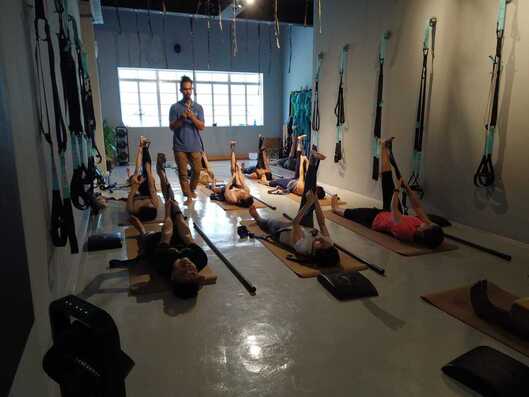
Yes. MSMC's Aerial Stretch class is designed for beginners & intermediate participants alike: no flexibility, strength or aerial experience is needed, your feet can stay on the floor, & upside-down positions are optional. You don't need a certain level of fitness: the instructor teaches the basics first, so you can achieve each position comfortably. It's a fun, safe way to explore aerial movement: the instructor checks your position & adjusts the support system of fabric to your height.
Quick answers to common stretching questions
What are 5 stretches to improve flexibility?
A simple set to enhance flexibility: a hamstring stretch lying on your back, a calf stretch against a wall, a half-kneeling hip flexor stretch, a doorway chest & shoulder stretch, & child's pose for the back. Each can also be performed in the aerial hammock, which takes pressure off the knees & wrists.
Is stretching 20 minutes a day enough?
For most people, yes. Short, regular sessions of 10 to 20 minutes on most days are enough to improve flexibility over a few weeks; doing it often matters more than doing it for long.
Can you overdo static stretching?
Yes. Forcing a stretch past the point of mild discomfort, bouncing, or holding a painful position can strain a muscle. A sharp or lingering pain is a sign to ease off; safety comes before range.
What is the difference between flexibility & mobility?
Flexibility is how far a muscle can lengthen; mobility is how well you can actively move & control a joint through its range. Stretching mainly builds flexibility; strength & movement practice turn it into mobility.
Does stretching help with sore muscles after exercise?
Not much. The 2025 expert consensus above found stretching is largely inefficient as a recovery tool after exercise. Gentle movement, sleep & time help more.
Is aerial yoga harder than normal yoga?
It can be, when a class includes inversions & more upper body work. Beginner aerial yoga & aerial stretch classes are often easier than mat yoga, because the hammock supports you.
Who should avoid aerial yoga or aerial stretching?
Most people don't need to avoid aerial yoga or aerial stretching, but see a doctor first, & tell your trainer before class, if you are pregnant; have uncontrolled high blood pressure, heart disease or a history of stroke; have glaucoma or recent eye surgery (head-down positions raise eye pressure, Jasien et al., 2015); have had recent surgery or a joint replacement; or have severe osteoporosis, vertigo or a recent head injury. The same goes for severe or worsening pain, or pain with numbness, weakness or fever. Often this just means skipping upside-down positions. MSMC doesn't diagnose; we work alongside physiotherapists & doctors.
Aerial vs normal stretching FAQs
Is aerial stretching better than normal stretching?
Not for everyone. Aerial stretching gives more support, gentle traction & balance work, which helps many stiff beginners relax into stretches. Normal stretching is simpler & can be done anywhere. Most people find a mix of both beneficial.
Is aerial yoga better than normal yoga for stretching?
Aerial yoga makes many stretches easier to relax into because the hammock supports your body, but there's no shortcut: flexibility improves with regular practice over weeks, whichever you choose.
Do you need upper body strength for aerial yoga?
Not much for a beginner class. Inversions & more advanced aerial yoga need more upper body strength & core control, which builds with practice. An aerial stretch class needs very little strength, because the hammock does most of the holding.
What is the difference between assisted stretching & aerial stretching?
In aerial stretching you stretch yourself with a hammock's support in a small group. In assisted stretching, such as MSMC's F.S.T, a trainer stretches you one-to-one, focused on your own tight spots; one 30-minute F.S.T a month is included in ELITE, & you can ask on WhatsApp for the price of a single session. Learn more about stretch therapy in Singapore or what happens in an F.S.T session.
Is it too late to become flexible at 50 or 60?
No. Flexibility can improve at any age with regular, gentle practice. It may take longer as we get older, so consistency matters more than how far you can stretch on day one.
How much does aerial stretching cost at MSMC?
$45 for a 55-minute class with up to 9 people (as of November 2026), or included in the Pro ($300 a month, 12 classes) & ELITE ($369 a month, unlimited) memberships.
Last updated: 21 November 2026. Written by the MSMC team & reviewed by a sports medicine trained trainer.
Try aerial stretching at MSMC
The easiest way to feel the difference is to try a class. Book Aerial Stretch on Momence through our Aerial Stretch class page, or message us on WhatsApp at +65 8973 7619. If you have pain or an injury, start with our $190 full assessment so we can check how you move first. We're at 151A Kitchener Road, near Farrer Park MRT.