
You can start strength training in your 60s, & it's one of the most useful things you can do for your body at this age. Start with a check of how you move, begin with light, simple exercises two days a week, add balance work, & build up slowly with good form. At MSMC (Movement & Sports Medicine Centre) on Kitchener Road, near Farrer Park MRT, seniors start with a full assessment so the plan fits your joints, your health & your goals.
This guide explains why strength training matters after 60, how to start safely, simple exercises you can try, balance exercises for seniors, & how to choose between home exercise, a small class or a personal trainer in Singapore. Strength work is a key part of active ageing, & more seniors in Singapore are taking it up.
Strength training for seniors Singapore: key facts
- What it is: exercise that makes your muscles work against a weight, a band or your own body weight.
- Who it's for: adults in their 60s & older, including complete beginners & people with stiff joints.
- How often: at least two days a week of strength work, plus balance work, in line with WHO advice for older adults.
- First step at MSMC: a full assessment, $190 (as of November 2026).
- Classes: $45 per 55-minute class, small groups of up to 6 for Barbell Lifting & BFRT (as of November 2026).
- One-to-one: personal training with sports medicine trained (SMT) trainers, from $1,080 a month for 8 sessions, or $1,500 for 10 sessions (as of November 2026).
- Where: 151A Kitchener Road #02, Singapore 208526, near Farrer Park MRT.
- How to book: appointment based, closed Sundays & public holidays. Book on Momence or WhatsApp +65 8973 7619.
Is it too late to start strength training at 60?
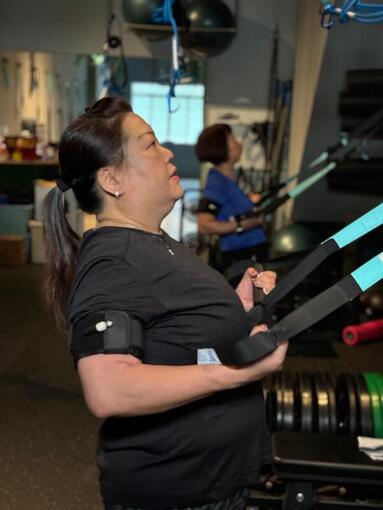
No. Muscles respond to resistance training at any age. In one well-known study, frail nursing home residents aged around 90 did 8 weeks of supervised, high-intensity strength training. Their strength more than doubled on average, their thigh muscles grew & their walking improved (Fiatarone et al., 1990). You may progress a little more slowly than you would have at 30, & you'll need more care with recovery, but the benefits for your strength, your ability to do everyday tasks & your quality of life are real. Whatever your fitness level, the starting point is simply where you are today.
Why is muscle strength key to active ageing, daily life & independence?
From middle age we slowly lose muscle, & this physical decline tends to speed up as we get older. This muscle loss with age is called sarcopenia. Less muscle can make everyday tasks, daily activities & daily function harder: climbing stairs, getting up from a chair, carrying groceries or getting on & off the MRT.
Strength training for seniors can help to:
- Stay independent in daily tasks like standing up, lifting & carrying, by keeping muscle mass, muscular strength & functional strength.
- Lower the risk of falls. Older adults have the highest risk of serious falls (WHO), & strength & balance training is one of the main ways to reduce that risk.
- Support bone health & bone density. Muscle-strengthening & weight-bearing exercise help keep bones strong (NHS).
- Ease stiff joints & joint pain. Stronger muscles around the knees, hips & back take some of the load off the joints & help mobility.
- Help your mood, mental health, sleep & energy levels, & your general health & well being. Improved mood is one of the first things many people notice with regular exercise, which also supports cardiovascular health, & the WHO notes regular activity is good for thinking & helps keep your mind sharp.
- Build confidence & ease the fear of falling, so you feel more able to get out & about.
How much exercise should a 60-year-old do to stay active?
The WHO & the NHS advise older adults to:
- Do 150 to 300 minutes of moderate activity a week, such as brisk walking.
- Do muscle-strengthening activities on at least two days a week.
- Do activities that improve balance & strength on three or more days a week, to help prevent falls.
- Sit less, & break up long periods of sitting.
In Singapore, HealthHub advises people aged 50 & over to do a mix of strength, balance & flexibility exercises at least 3 days a week to stay fit & prevent falls. Singapore's physical activity guidelines also recommend strength-training activities two days a week for adults & seniors (HealthHub). A simple way to check you're at a moderate effort: you can hold a conversation in short sentences, but not sing. If you're starting from very little, any amount is better than none. Build up week by week.
How do I start strength training safely in my 60s?
These steps work whatever your fitness levels are today, whether you walk every day or haven't exercised in years.
- Check with your doctor first if you have heart problems, high blood pressure that isn't well controlled, diabetes, osteoporosis, recent surgery or a recent fall.
- Get your movement assessed. A coach can identify which joints are stiff, which side is weaker & how your balance is; expert guidance like this helps you choose the right exercises from day one.
- Start light. Use your body weight, resistance bands or light dumbbells. You should be able to do 10 to 15 smooth repetitions.
- Focus on form. Slow, controlled movements protect your joints & work the muscles better.
- Build a simple exercise routine: train two days a week with a rest day in between to begin with.
- Add a little at a time. When an exercise feels easy for two sessions in a row, add a few repetitions or a little weight.
- Breathe. Don't hold your breath while lifting. Breathe out as you push or lift.
- Listen to your body. Mild muscle soreness for a day or two is normal. Sharp pain, or pain that keeps getting worse, isn't.
- Look after recovery. Sleep well & eat enough protein across the day to help your muscles repair.
- Give it time. Many studies of strength training in older adults run for 8 to 12 weeks or more, so judge your progress over a few months, not a few sessions.
What are the best strength exercises for seniors?
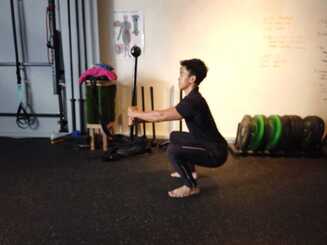
These simple exercises work the main muscles you use every day. Do 1 to 2 sets of 8 to 12 repetitions, two days a week. Hold on to a sturdy chair or wall if you need to.
| Exercise | How to do it | Helps with |
|---|---|---|
| Sit to stand | Sit on a firm chair, feet flat. Stand up without using your hands if you can, then sit back down slowly. | Getting up from chairs, toilets & cars |
| Wall push-up | Stand an arm's length from a wall, hands on the wall at shoulder height. Bend your elbows to bring your chest towards the wall, then push back. | Pushing, getting up off the floor |
| Step-up | Step up onto the bottom stair holding the rail, then step down. Swap legs. | Stairs & kerbs |
| Glute bridge | Lie on your back, knees bent. Squeeze your buttocks & lift your hips, then lower slowly. | Hip strength & lower back support |
| Band row | Loop a resistance band round a sturdy post. Pull the ends towards your ribs, squeezing your shoulder blades together. | Posture & carrying |
| Heel raise | Hold a chair, rise up onto your toes, then lower slowly. | Calf strength, walking & balance |
Together these work the upper & lower body. The NHS strength exercises page has more simple moves for older adults.
How do I do a sit to stand?
This exercise focuses on the lower body: the thighs & buttocks you use to get up from any seat.
- Starting position: sit tall near the front of a stable chair, feet hip width apart & flat on the floor.
- Lean forward a little & push through your heels to stand up. Use your hands on the chair if you need to.
- Stand fully upright, then slowly lower yourself back to the starting position in a controlled manner.
How do I do a wall push-up?
This works the upper body: chest, shoulders & the back of the upper arm.
- Stand an arm's length from a wall, feet hip width apart, hands flat on the wall at shoulder height.
- Keep your body straight & bend your elbows to bring your chest towards the wall.
- Push back to the starting position. Breathe out as you push.
How do I do standing hip abduction?
Hip abduction means lifting your leg out to the side. It strengthens the side hip muscles that help you balance on one leg when you walk.
- Stand behind a stable chair or another sturdy surface for stable support, with knees slightly bent & an upright posture.
- Lift your right leg out to the side without leaning your body, then slowly lower it.
- Do all your repetitions, then switch to the left leg. Once it's easy, light ankle weights can add controlled resistance.
How do I do biceps curls?
- Sit tall or stand with feet hip width apart, holding light weights by your sides, palms facing forward.
- Keep your upper arm still & bend your elbows to bring the weights up.
- Slowly lower back to the starting position. This muscle group helps with lifting & carrying groceries.
Start each muscle group with light weights or just your body weight, then gradually increase the load as you get stronger. To build gradually like this is the best way to prevent injury & make steady progress on your fitness journey.
What balance exercises should seniors do?
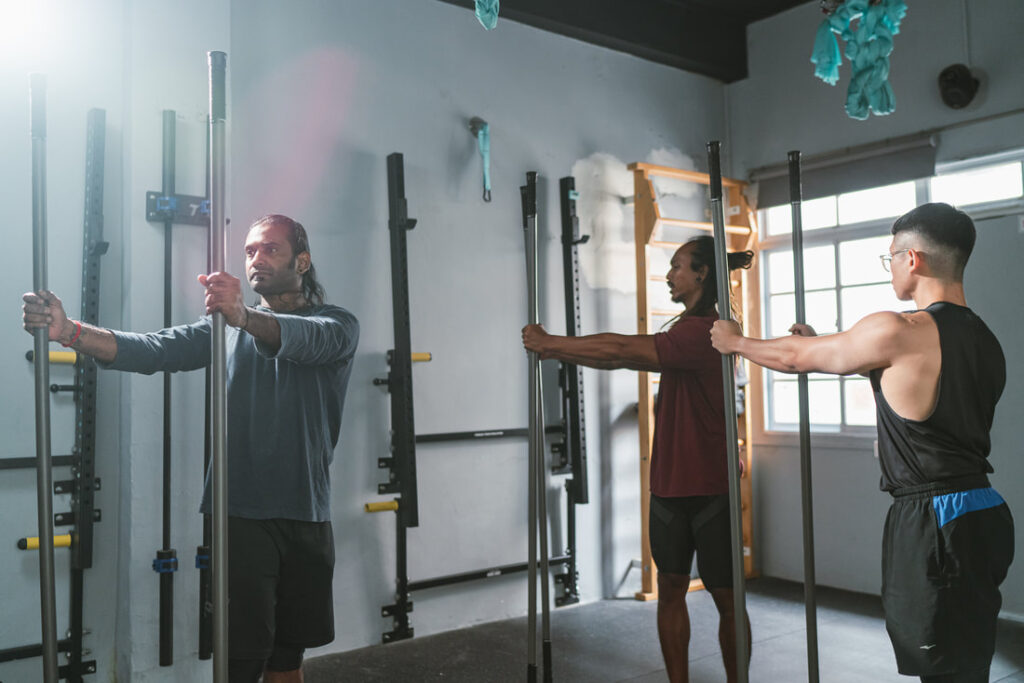
Balance exercises for seniors are just as crucial as strength work, because good balance helps prevent falls. Do these near a wall or sturdy chair you can hold if needed (NHS balance exercises):
- Single-leg stand: hold a chair & lift your left foot so you stand on one leg. Hold for up to 10 seconds, then lift your right foot & stand on the opposite leg. As it gets easier, hold on with one finger, then not at all.
- Heel-to-toe walk: walk in a straight line, putting the heel of one foot just in front of the toes of the other.
- Side leg raise: hold a chair & lift one leg out to the side, keeping your body upright.
- Sit to stand, slowly: the slower you go, the more it trains balance & control.
Is weight training safe for seniors?
Weight training for seniors is generally safe when it's well planned, starts light & builds up gradually, & when red flags have been checked by a doctor. Using machines, bands, dumbbells or even a barbell can all work. Gym machines give support & a fixed path, which many beginners find easier on the joints, while free weights train balance & control too. What matters is good technique, the right load & enough rest; a little education on safe lifting practices goes a long way. A trainer who assesses you first can choose the safest version of each exercise for your joints.
See a doctor first before you start, or stop & seek help, if you have chest pain or pressure, feel faint or dizzy, become very short of breath, have a racing or irregular heartbeat, or have a new, severe pain in a joint or your back. If you've had a recent fall, a fracture or surgery, get medical advice before you begin.
What exercises should seniors avoid?
Very few exercises are off limits for everyone, but some need care, especially for elderly people with osteoporosis, joint pain or balance problems:
- Anything that causes sharp pain. Change the exercise, the range or the weight instead.
- Holding your breath while lifting heavy. It can push up your blood pressure.
- Fast, jerky movements before you've built control. Move slowly first, then add speed later if it suits you.
- High-impact jumping if you have osteoporosis, a past fracture or painful knees, unless your doctor or physio says it's fine.
- Lots of deep forward bending & twisting with a load if you have osteoporosis of the spine. The Royal Osteoporosis Society has guidance on moving safely.
A good trainer will swap these for safer versions so you can still train the same muscles.
Light weights or heavy lifting: how much should a senior lift?
There's no magic number. The right weight is one you can lift 10 to 15 times with good form, where the last few repetitions feel hard but not painful. For one person that's a 1kg dumbbell, for another it's a heavy barbell. In a gym, start lighter than you think (this is about safe progress, not gym performance), & move to heavier weights only when the exercise feels easy for two sessions in a row. Your weight will go up over the months, & that's the clearest sign of progress. That sense of progress can lead to more confidence, too.
Body weight, resistance bands or free weights: which should seniors use?
All of them can build strength. Bodyweight exercises like sit to stand & wall push-ups need no equipment, so they're a good place to start at home. Resistance bands are cheap & light, & give smooth, controlled resistance that's kind to stiff joints. Free weights such as dumbbells train balance & control too, & make it easy to add a little load at a time. Many people use a mix: body weight to learn the movement, then bands or free weights to keep making it harder. This kind of functional movement training carries straight over to daily life.
Can older adults with chronic conditions build strength?
Yes, in most cases. The WHO guidelines on physical activity include people living with chronic conditions, & say muscle strengthening benefits everyone. If you have heart disease, diabetes, high blood pressure, arthritis or other medical conditions, check with your doctor first & share your medical history & current health with your trainer. If you have a joint or back problem, a physiotherapist (called a physical therapist in some countries) can help too. The plan is then built around you, often with lighter loads, longer rests & closer watching of how you feel.
Should I train at home, in a class or with personal training?
All three can work. The right choice depends on your health, any limitations, your confidence & how much guidance you want. Community centres & eldercare centres in Singapore also run exercise programmes for seniors, which can be a good low-cost option if you have no pain or health conditions to work around.
| Option | Good for | Things to think about | At MSMC (as of November 2026) |
|---|---|---|---|
| Home exercise | Getting started with simple moves, low cost | No one checks your form or adjusts the plan | Works well between classes or PT sessions |
| Small group class | Learning lifts with coaching, staying motivated, meeting people | Less one-to-one attention than PT | $45 per 55-minute class; Barbell Lifting & BFRT have up to 6 people |
| Personal trainer | Pain, stiff joints, past injuries, health conditions or nervous beginners | Costs more | From $1,080 a month (8 sessions) or $1,500 for 10 sessions, after a $190 assessment |
If you're weighing up trainers, our guide on how to choose a personal trainer in Singapore lists the 10 questions to ask.
Where can I find strength training for seniors in Singapore?
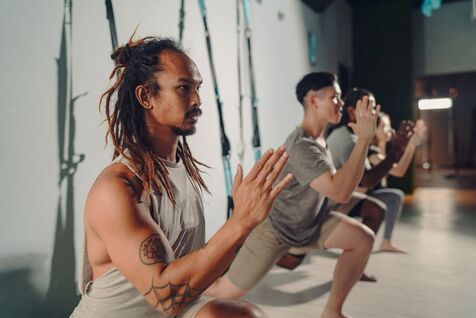
You have a few choices: community & eldercare centre programmes, public & private gyms, small group classes & one-to-one personal training. Healthy, confident individuals may do well in a well-run gym or community programme. If you have pain, past injuries, health conditions or you're a complete beginner, look for a coach with experience of older clients who will assess you first & give you clear guidance at every session. A calm, safe environment & coaches with a real interest in senior fitness make a big difference, & training with others can give emotional support & practical motivation to keep going.
What does strength training for seniors look like at MSMC?
Most people we see are adults from their mid-30s to their 60s, often with pain or stiffness that physio, chiro, TCM or a regular trainer hasn't fully fixed. Our trainers are sports medicine trained & work alongside physiotherapists. We don't diagnose. We test how you move & train you from there.
- Full assessment ($190): your history, goals, joint movement, strength & balance.
- Personal training: a one-to-one training programme built around your results, your needs & your lifestyle. Each session is one-to-one with a sports medicine trained coach, & you're retested as you go so you can see your progress.
- Small classes: Barbell Lifting teaches the main lifts with coaching, & BFRT (blood flow restriction training) uses a special cuff so you can train with lighter weights. Ask your doctor first about BFRT if you have circulation problems, blood clots or heart problems.
- Mobility classes: Bandit Stretch, Deep Roll 2.0 (foam rolling & release) & Stretch Mob help with stiffness alongside your strength work.
For more on training after 50, read our guide to the best personal trainer for over 50s in Singapore, our page on seniors strength training classes, & for women, strength training for women in their 50s.
What does a simple first-week exercise routine look like?
Here's a simple fitness plan for your first week. It mixes strength, walking, balance & rest.
| Day | What to do |
|---|---|
| Day 1 | Strength: sit to stand, wall push-up, glute bridge, band row, heel raise. 1 set of 8 to 10 each. |
| Day 2 | A 20 to 30-minute walk, plus 5 minutes of balance exercises. |
| Day 3 | Rest or gentle stretching. |
| Day 4 | Strength again, same exercises. Add a second set if the first felt easy. |
| Day 5 | A walk plus balance exercises. |
| Days 6 & 7 | Stay active: walking, gardening, swimming or a stretch class. |
This is a general example, not a personal plan. If you have pain or a health condition, get assessed first.
Frequently asked questions
How often should seniors do strength training?
At least two days a week, with balance work on three or more days, as advised by the WHO & NHS.
What is the best exercise for elderly people in Singapore?
A mix works best: walking or other moderate activity, strength exercises like sit to stand & step-ups, & balance exercises. Choose what you enjoy & can keep doing.
Does strength training help bone health in older adults?
Yes. Muscle-strengthening & weight-bearing exercise help keep bones strong & support bone density as you age (NHS). If you have osteoporosis, ask your doctor which exercises suit you.
Is lifting weights bad for your joints after 60?
Not when it's done with good form & the right load. Stronger muscles often help support stiff joints. If a joint is painful, get it checked first.
Should I see a doctor before starting strength training?
Yes, if you have heart problems, uncontrolled blood pressure, diabetes, osteoporosis, a recent fall, fracture or surgery, or any symptoms like chest pain or dizziness.
How much does strength training for seniors cost at MSMC?
The full assessment is $190, classes are $45 each, & personal training starts at $1,080 a month for 8 sessions or $1,500 for 10 sessions (as of November 2026).
What if I've never been to a gym?
That's fine. Many people start in their 60s as a complete beginner. Begin with an assessment & simple exercises, & build up at your own pace. Your fitness level today is just the starting point.
Last updated: 21 November 2026. Written by the MSMC team & reviewed by a sports medicine trained trainer.
Ready to start?
If you'd like to start strength training safely, book your full assessment ($190) at MSMC, 151A Kitchener Road, near Farrer Park MRT. Book on Momence or message us on WhatsApp at +65 8973 7619. We'll start where you are.